
Screen#
Introduction#
The Screen methods control how the IQ (2nd gen) Brain shows text, numbers, and graphics on its built-in screen.
For drawing, the Brain’s resolution is 160 x 108 pixels.
This page uses brain as the example Brain name. Replace it with your own configured name as needed.
Below is a list of all methods:
Cursor Print — Place and print text.
print— Prints text, numbers, or variable values at the current cursor position.set_cursor— Moves the cursor to a specific row and column.next_row— Moves the cursor to column 1 of the next row.clear_row— Clears a row of text.row— Returns the row where text will be printed.column— Returns the column where text will be printed.print_at— Prints text, numbers, or variable values at a specific x and y coordinate.get_string_width— Returns the width of a string in pixels using the current font.get_string_height— Returns the height of a string in pixels using the current font.
Mutators — Change screen settings, colors, and drawing behavior.
clear_screen— Clears the screen of all drawings and text.set_font— Sets the font for printed text.set_pen_width— Sets the thickness of drawn lines and shape outlines.set_pen_color— Sets the color of text, pixels, lines, and shape outlines.set_fill_color— Sets the fill color for drawn shapes and printed text backgrounds.set_origin— Sets the origin used for coordinate-based printing and drawing.
Draw — Add graphics to the screen.
draw_pixel— Draws one pixel at a coordinate.draw_line— Draws a line between two points.draw_rectangle— Draws a rectangle.draw_circle— Draws a circle.set_clip_region— Restricts where drawings and text can appear.render— Updates the Brain’s screen with text and drawings only when called.
Cursor Print#
print#
print prints text, numbers, or variable values on the Brain screen at the current cursor position and font.
Usage:
brain.screen.print(text, precision, opaque)
Parameters |
Description |
|---|---|
|
The text, number, or variable value to print on the screen. |
|
Optional. The number of decimal places to display when displaying numbers. This must be written as a keyword argument, ie: |
|
Optional. |
# Display a message at the starting
# cursor position
brain.screen.print("Hello, Robot!")

# Display a percentage with 4 decimal
# places and a blue background
brain.screen.set_fill_color(Color.BLUE)
brain.screen.print((42/100), precision = 4, opaque = True)
set_cursor#
set_cursor moves the cursor to a specific row and column on the Brain screen. The next print call will start printing at that location. How many rows and columns can comfortably fit depends on the selected font.
Monospaced fonts have characters that are all the same width, making text placement consistent. In contrast, proportional fonts vary in character width, so some letters take up more space than others. However, regardless of which type is used, set_cursor positions the cursor based on row and column size, not font style. The font size can be adjusted using set_font.
Usage:
brain.screen.set_cursor(row, column)
Parameters |
Description |
|---|---|
|
The row to move the cursor to. |
|
The column to move the cursor to. |
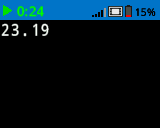
# Repeatedly print the Brain's timer at
# the top left of the screen
while True:
    brain.screen.print(brain.timer.time(SECONDS))
    brain.screen.next_row()
    wait(1, SECONDS)
    brain.screen.clear_screen()
    brain.screen.set_cursor(1, 1)
next_row#
next_row moves the cursor to column 1 on the next row on the Brain screen.
Usage:
brain.screen.next_row()
Parameters |
Description |
|---|---|
This method has no parameters. |
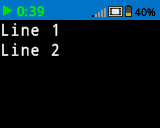
# Display two lines of text
brain.screen.print("Line 1")
brain.screen.next_row()
brain.screen.print("Line 2")
clear_row#
clear_row clears a single row of text on the Brain screen.
Usage:
brain.screen.clear_row(row, color)
Parameters |
Description |
|---|---|
row |
Optional. The row to clear. The default is the current cursor row. |
color |
Optional. The color to apply to the cleared row. Options include:
|
# Display text on two rows
brain.screen.print("This text stays")
brain.screen.next_row()
brain.screen.print("This disappears")

# Wait 3 seconds before clearing
# only the second row
wait(3, SECONDS)
brain.screen.clear_row()
# Turn the 5th row green
brain.screen.clear_row(5, Color.GREEN)
row#
row returns the row where text will be printed as an integer.
Usage:
brain.screen.row()
Parameters |
Description |
|---|---|
This method has no parameters. |
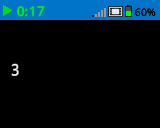
# Set cursor to (3,2) and print
# row number
brain.screen.set_cursor(3, 2)
brain.screen.print(brain.screen.row())
column#
column returns the column where text will be printed as an integer.
Usage:
brain.screen.column()
Parameters |
Description |
|---|---|
This method has no parameters. |
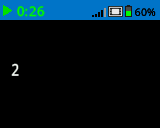
# Set cursor to (3,2) and print
# column number
brain.screen.set_cursor(3, 2)
brain.screen.print(brain.screen.column())
print_at#
print_at prints text, numbers, or variable values on the Brain screen at a specified x and y coordinate in pixels with the currently set font and origin. This method disregards the current cursor position.
Usage:
brain.screen.print_at(text, x, y, precision, opaque)
Parameters |
Description |
|---|---|
|
The text, number, or variable value to print. |
|
The x-coordinate to print at as a keyword argument, ie: |
|
The y-coordinate to print at as a keyword argument, ie: |
|
Optional. The number of decimal places to display when displaying numbers. This must be written as a keyword argument, ie: |
|
Optional. |
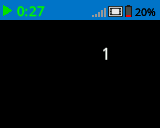
# Print the number 1 on the Brain's screen at position (100, 40)
brain.screen.print_at(1, x=100, y=40)
# Display 1/3 with 3 decimal places and a blue background
brain.screen.set_fill_color(Color.BLUE)
brain.screen.print_at((1/3), x=100, y=40, precision=3, opaque=True)
get_string_width#
get_string_width returns the width of a string in pixels as an integer, as it would appear on the Brain’s screen. The width varies depending on the string’s length and the current font.
Usage:
brain.screen.get_string_width(string)
Parameters |
Description |
|---|---|
|
The string to measure. |
get_string_height#
get_string_height returns the height of a string in pixels as an integer, as it would appear on the Brain screen. The height varies depending on the string’s length and the current font.
Usage:
brain.screen.get_string_height(string)
Parameters |
Description |
|---|---|
|
The string to measure. |
Mutators#
clear_screen#
clear_screen clears all drawings and text from the Brain’s screen.
Usage:
brain.screen.clear_screen(color)
Parameters |
Description |
|---|---|
|
Optional. Sets the screen color. Options include:
|
# Draw a circle and clear it after
# 2 seconds
brain.screen.draw_circle(80, 50, 20)
wait(2, SECONDS)
brain.screen.clear_screen()
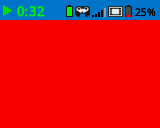
# Turn the screen red
brain.screen.clear_screen(Color.RED)
set_font#
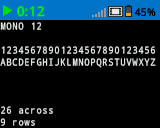
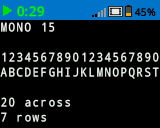
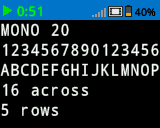
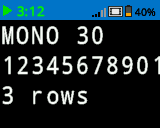
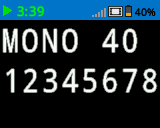
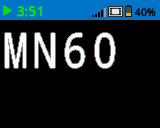
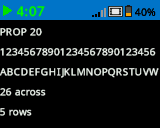
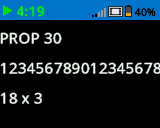
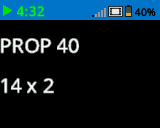
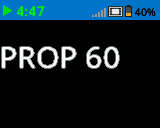
set_font sets the font used for displaying text on the Brain screen. This font will apply to all text printed with print or print_at. The default font at the start of a project is MONO20.
Usage:
brain.screen.set_font(fontname)
Parameter |
Description |
|---|---|
|
Sets the font to one of the following:
|
|
|
|
|---|---|---|
|
|
|
|
|
|
|
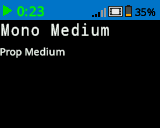
# Display two different fonts on
# two separate lines
brain.screen.set_font(FontType.MONO20)
brain.screen.print("Mono Medium")
brain.screen.next_row()
brain.screen.set_font(FontType.PROP20)
brain.screen.print("Prop Medium")
set_pen_width#
set_pen_width sets the thickness of drawn lines and shape outlines.
Usage:
brain.screen.set_pen_width(width)
Parameter |
Description |
|---|---|
|
The pen width, in pixels, from 0 to 32. |
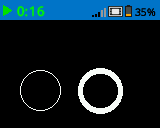
# Draw two circles with
# different pen widths
brain.screen.draw_circle(40, 70, 20)
brain.screen.set_pen_width(5)
brain.screen.draw_circle(100, 70, 20)
set_pen_color#
set_pen_color sets the color of text, pixels, lines, and shape outlines.
Usage:
brain.screen.set_pen_color(color)
Parameter |
Description |
|---|---|
|
Optional. The pen and font color to use. Options include:
|
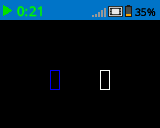
# Draw two rectangles with
# different colors
brain.screen.draw_rectangle(100, 50, 10, 20)
brain.screen.set_pen_color(Color.BLUE)
brain.screen.draw_rectangle(50, 50, 10, 20)
set_fill_color#
set_fill_color sets the fill color used when shapes are drawn.
Usage:
brain.screen.set_fill_color(color)
Parameter |
Description |
|---|---|
|
Optional. The fill color to use. Options include:
|
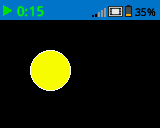
# Draw a yellow circle
brain.screen.set_fill_color(Color.YELLOW)
brain.screen.draw_circle(50, 50, 20)
set_origin#
set_origin sets the origin used for drawing and coordinate-based printing on the Brain screen. By default, the origin is the top-left corner of the screen.
Usage:
brain.screen.set_origin(x, y)
Parameter |
Description |
|---|---|
|
The new x-coordinate to set as the origin, given as an integer from 0 to 159. |
|
The new y-coordinate to set as the origin, given as an integer from 0 to 107. |
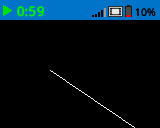
# Draw a line with the origin set to (50, 50)
brain.screen.set_origin(50, 50)
brain.screen.draw_line(1, 1, 159, 107)
Draw#
draw_pixel#
draw_pixel draws one pixel at the selected x and y coordinate using the current pen color.
Usage:
brain.screen.draw_pixel(x, y)
Parameter |
Description |
|---|---|
|
The x-coordinate where the pixel will be drawn, given as an integer from 0 to 159. |
|
The y-coordinate where the pixel will be drawn, given as an integer from 0 to 107. |
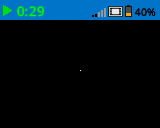
# Draw one pixel at the center
# of the screen
brain.screen.draw_pixel(80, 50)
draw_line#
draw_line draws a line from the first screen coordinate (x1, y1) to the second screen coordinate (x2, y2) using the current pen width and pen color.
The x and y-coordinates use the default origin of (0, 0) unless a different origin has been set using set_origin.
Usage:
brain.screen.draw_line(x1, y1, x2, y2)
Parameter |
Description |
|---|---|
|
The starting x-coordinate of the line, given as an integer from 0 to 159. |
|
The starting y-coordinate of the line, given as an integer from 0 to 107. |
|
The ending x-coordinate of the line, given as an integer from 0 to 159. |
|
The ending y-coordinate of the line, given as an integer from 0 to 107. |
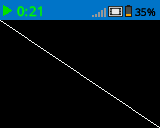
# Draw a line from the top left to
# bottom right of the screen
brain.screen.draw_line(0, 0, 159, 107)
draw_rectangle#
draw_rectangle draws a rectangle with its top-left corner at the selected (x, y) coordinate and a size determined by the given width and height, all measured in pixels. The rectangle’s outline is drawn using the current pen width and pen color. The interior is filled with the current fill color, unless the optional color parameter is used.
The x and y-coordinates use the default origin of (0,0) unless a different origin has been set using set_origin.
Usage:
brain.screen.draw_rectangle(x, y, width, height, color)
Parameter |
Description |
|---|---|
|
The x-coordinate of the top-left corner of the rectangle, given as an integer from 0 to 159. |
|
The y-coordinate of the top-left corner of the rectangle, given as an integer from 0 to 107. |
|
The width of the rectangle, in pixels. |
|
The height of the rectangle, in pixels. |
|
Optional. The fill color of the rectangle. Options include:
|
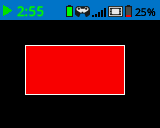
# Draw a red rectangle on the screen
brain.screen.draw_rectangle(25, 25, 100, 50, Color.RED)
draw_circle#
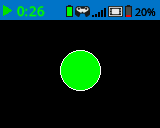
draw_circle draws a circle with its center at the selected (x, y) coordinate and a size determined by the given radius, all measured in pixels. The circle’s outline is drawn using the current pen width and pen color. The interior is filled with the current fill color, unless the optional color parameter is used.
The x and y-coordinates use the default origin of (0,0) unless a different origin has been set using set_origin.
Usage:
brain.screen.draw_circle(x, y, radius, color)
Parameter |
Description |
|---|---|
|
The x-coordinate of the center of the circle, given as an integer from 0 to 159. |
|
The y-coordinate of the center of the circle, given as an integer from 0 to 107. |
|
The radius of the circle, in pixels. |
|
Optional. The fill color of the circle. Options include:
|
# Draw a green circle on the screen
brain.screen.draw_circle(80, 50, 20, Color.GREEN)
set_clip_region#
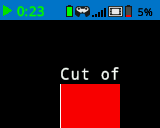
set_clip_region defines a rectangular area on the screen where all drawings and text will be confined. Any content outside this region will not be displayed.
Usage:
brain.screen.set_clip_region(x, y, width, height)
Parameter |
Description |
|---|---|
|
The x-coordinate of the top-left corner of the clip region, given as an integer or float from 0 to 159. |
|
The y-coordinate of the top-left corner of the clip region, given as an integer or float from 0 to 107. |
|
The width of the clip region in pixels. |
|
The height of the clip region in pixels. |
# Restrict text and drawings to a specific region
brain.screen.set_clip_region(0, 0, 120, 120)
brain.screen.draw_rectangle(60, 60, 100, 100, Color.RED)
brain.screen.print_at("Cut off!", x=60, y=60)
render#
render enables double buffering for the Brain’s screen. Once called, any drawing commands (like text, shapes, or images) will no longer appear immediately for the rest of the project. Instead, updates will only be shown when render is used again. This allows for smoother and more controlled screen updates, but means nothing will be visible until render is used.
Usage:
brain.screen.render()
Parameters |
Description |
|---|---|
This method has no parameters. |
# Render text after moving
brain.screen.render()
brain.screen.print("Render later...")
drivetrain.drive_for(FORWARD, 100, MM)
drivetrain.turn_for(RIGHT, 90, DEGREES)
brain.screen.render()