
Optical Sensor#
Introduction#
The Optical Sensing category includes blocks that control and retrieve data from the VEX IQ Optical Sensor. This sensor can detect objects, identify colors, and measure brightness and hue.
The Optical Sensor has a light that can be turned on or off. The light can help the Optical Sensor detect objects and colors more clearly.
Below is a list of all blocks:
set Optical light — Turns the Optical Sensor light on or off.
set Optical light power — Sets the brightness of the Optical Sensor’s light.
Optical found an object? — Reports whether an object is detected.
Optical detects color? — Reports whether a specific color is detected.
Optical color name — Reports the name of the color detected.
Optical brightness — Reports the brightness detected by the sensor.
Optical hue — Reports the hue value of the detected color.
When Optical — Runs the attached stack of blocks when the Optical Sensor detects or loses an object.
set Optical light#
The set Optical light stack block turns the light on the Optical Sensor on or off. The light lets the Optical Sensor see objects better if it is looking at an object in a dark area.
set [Optical1 v] light [on v]
Parameters |
Description |
|---|---|
optical sensor |
Which Optical Sensor to use, configured in the Devices window. |
state |
The state of the Optical Sensor’s light to set:
|
Example
    when started
    [Repeatedly flash the Optical Sensor's lights.]
    forever
    set [Optical1 v] light [on v]
    wait (1) seconds
    set [Optical1 v] light [off v]
    wait (1) seconds
set Optical light power#
The set Optical light power stack block sets how bright the Optical Sensor’s light is. The light can help the Optical Sensor detect objects and colors more clearly.
A higher percentage makes the light brighter. A lower percentage makes the light dimmer.
If the Optical Sensor’s light is off, setting the light power above 0% will turn the light on.
If the Optical Sensor’s light is on, setting the light power at 0% will turn the light off.
set [Optical1 v] light power to (50) %
Note: If the Optical Sensor’s light is off, this block will turn the light on.
Parameters |
Description |
|---|---|
optical sensor |
Which Optical Sensor to use, configured in the Devices window. |
brightness |
The brightness of the Optical Sensor’s light from 0 to 100 as a percent. |
Example
    when started
    [Repeatedly change the brightness of the Optical Sensor's lights.]
    forever
    set [Optical1 v] light power to (10) %
    wait (2) seconds
    set [Optical1 v] light power to (50) %
    wait (2) seconds
    set [Optical1 v] light power to (100) %
    wait (2) seconds
Optical found an object?#
The Optical found an object? Boolean block reports whether the Optical Sensor detects an object within range.
True — The Optical Sensor has detected an object.
False — The Optical Sensor has not detected an object.
<[Optical1 v] found an object?>
Parameters |
Description |
|---|---|
optical sensor |
Which Optical Sensor to use, configured in the Devices window. |
Example
    when started
    [Turn until the Optical Sensor detects an object.]
    set turn velocity to (10) [% v]
    set [Optical1 v] light power to [75] %
    turn [right v]
    wait until <[Optical1 v] found an object?>
    print [Object detected] on screen ◀ and set cursor to next row
    stop driving
Optical detects color?#
The Optical detects color? Boolean block reports whether the Optical Sensor detects a specific color.
True — The Optical Sensor has detected the specified color.
False — The Optical Sensor has not detected the specified color.
<[Optical1 v] detects [red v]?>
Parameters |
Description |
|---|---|
optical sensor |
Which Optical Sensor to use, configured in the Devices window. |
color |
Which color to check for:
|
Example
    when started
    [Turn until the Optical Sensor detects a red object.]
    set turn velocity to (10) [% v]
    set [Optical1 v] light power to [75] %
    turn [right v]
    wait until <[Optical1 v] detects [red v]?>
    print [Red detected] on screen ◀ and set cursor to next row
    stop driving
Optical color name#
The Optical color name reporter block reports the name of the color detected by the Optical Sensor.
Possible colors are:
red
green
blue
yellow
orange
purple
cyan
Note: This block can be inserted into the set Touch LED color block to make the Touch LED match the detected color.
([Optical1 v] color name)
Parameters |
Description |
|---|---|
optical sensor |
Which Optical Sensor to use, configured in the Devices window. |
Example
    when started
    [Display a message when the Optical Sensor detects red.]
    wait until <[Optical1 v] detects [red v]?>
    print ([Optical1 v] color name) on screen ◀ and set cursor to next row
Optical brightness#
The Optical brightness reporter block reports how bright the detected light is, as a percentage from 0% to 100%.
A higher percentage means the Optical Sensor detects more light. A lower percentage means the Optical Sensor detects less light.
([Optical1 v] brightness in %)
Parameters |
Description |
|---|---|
optical sensor |
Which Optical Sensor to use, configured in the Devices window. |
Example
    when started
    [Display the brightness when the Optical Sensor detects red.]
    wait until <[Optical1 v] detects [red v]?>
    print ([Optical1 v] brightness in %) on screen ◀ and set cursor to next row
Optical hue#
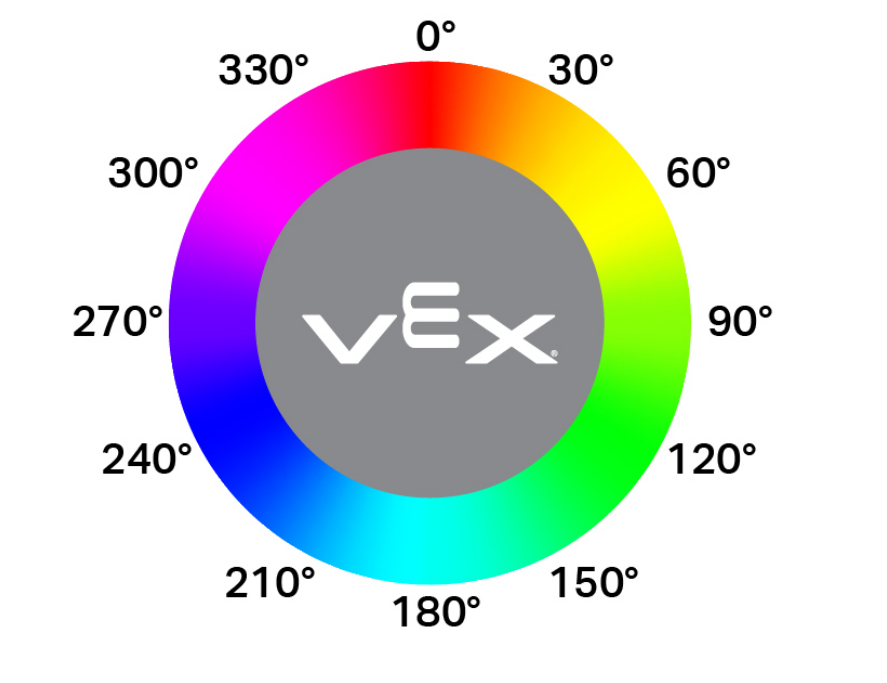
The Optical hue reporter block reports the hue detected by the Optical Sensor as a number from 0 to 359 degrees.
Hue is a way to describe color using numbers around a color wheel, as shown below:
([Optical1 v] hue in degrees)
Parameters |
Description |
|---|---|
optical sensor |
Which Optical Sensor to use, configured in the Devices window. |
Example
    when started
    [Print when the Optical Sensor detects pink.]
    forever
    clear screen
    set cursor to row (1) column (1) on screen
    if <<([Optical1 v] hue in degrees) [math_greater_than v] [290]> [and v] <([Optical1 v] hue in degrees) [math_less_than v] [350]>> then
    print [Pink!] on screen ▶
    wait (0.1) seconds
    else
    print [Not pink.] on screen ▶
    wait (0.1) seconds
When Optical#
The When Optical hat block runs the attached stack of blocks when the selected Optical Sensor detects or loses an object.
when [Optical1 v] [detects v] an object
Parameters |
Description |
|---|---|
optical sensor |
Which Optical Sensor to use, configured in the Devices window. |
state |
When the attached stack of blocks will run:
|
Example
    when [Optical1 v] [detects v] an object
    [Find an object when it is lost.]
    turn [right v]
    wait until <[Optical1 v] found an object?>
    stop driving