Button#

Introduction#

The button class is derived from the controller base class and provides access to the V5 Controller’s buttons, allowing your robot to monitor presses to the controller’s buttons.

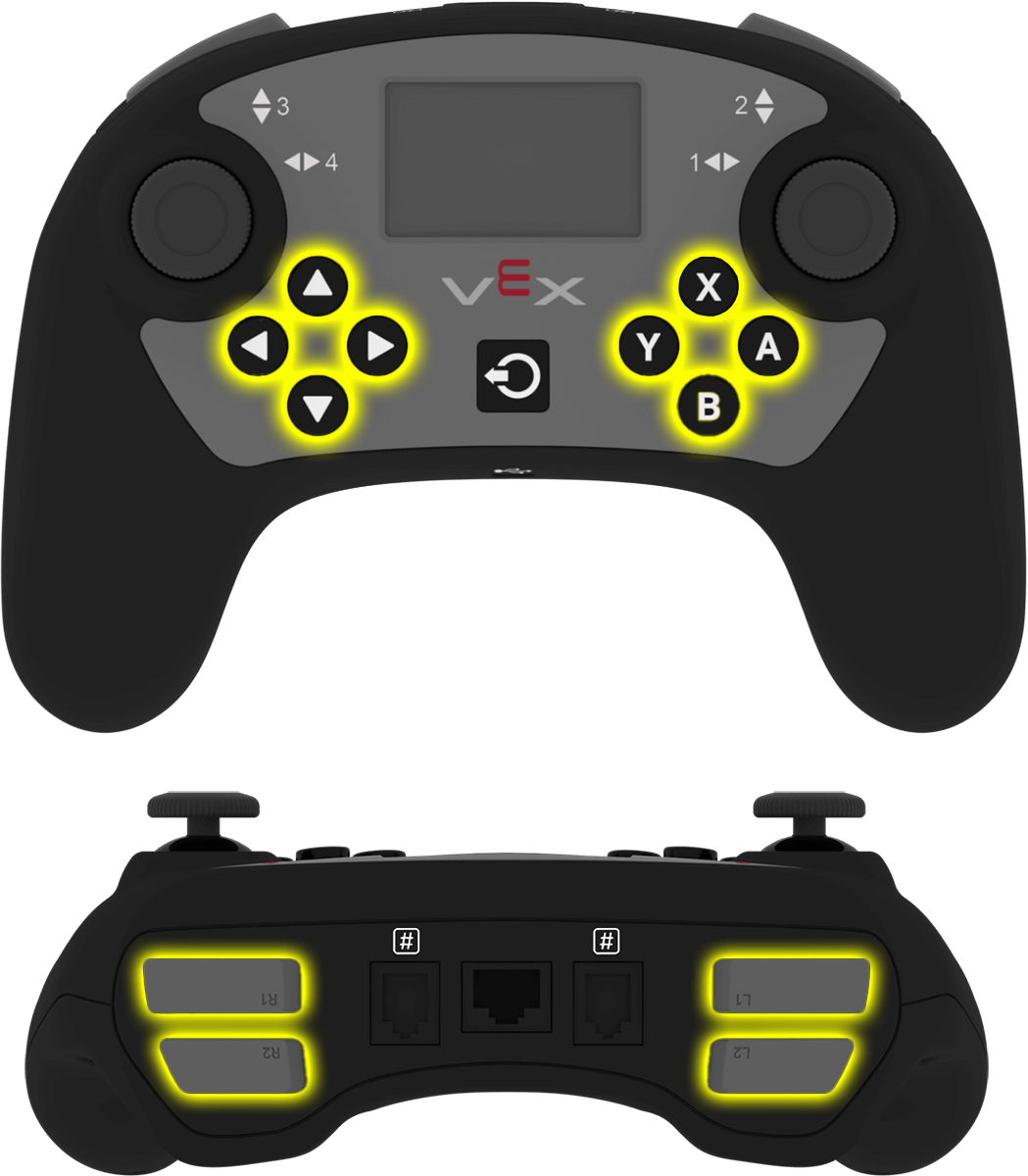
A VEX V5 Controller buttons highlighted yellow.

Access#

The controller class provides twelve button objects. Each object is an instance of the button class and can be accessed through a controller instance.

Object

Example Usage

Description

ButtonA

Controller.ButtonA.pressing()

A button

ButtonB

Controller.ButtonB.pressing()

B button

ButtonX

Controller.ButtonX.pressing()

X button

ButtonY

Controller.ButtonY.pressing()

Y button

ButtonUp

Controller.ButtonUp.pressing()

Up button

ButtonDown

Controller.ButtonDown.pressing()

Down button

ButtonLeft

Controller.ButtonLeft.pressing()

Left button

ButtonRight

Controller.ButtonRight.pressing()

Right button

ButtonL1

Controller.ButtonL1.pressing()

L1 button

ButtonL2

Controller.ButtonL2.pressing()

L2 button

ButtonR1

Controller.ButtonR1.pressing()

R1 button

ButtonR2

Controller.ButtonR2.pressing()

R2 button

Notes#

  • The button object is provided by the controller. It is not constructed directly.

Member Functions#

The Button class includes the following member functions:

  • pressing — Returns whether or not the specified button is being pressed.

  • pressed — Registers a function to be called when the specified button is pressed.

  • released — Registers a function to be called when the specified button is released.

Before calling any button member functions, a controller instance must be created, as shown below:

// Create a V5 controller instance
controller Controller = controller();

pressing#

Returns whether a specific controller button is currently being pressed.

Available Functions
bool pressing() const;

Parameters

This function does not accept any parameters.

Return Values

Returns an integer indicating whether the specified button is being pressed:

  • 1 — The button is being pressed.
  • 0 — The button is not being pressed.
Examples

This function can be called on any controller button object, for example:

  • Controller.ButtonA
  • Controller.ButtonB
  • Controller.ButtonX
  • Controller.ButtonY
  • Controller.ButtonDown
  • Controller.ButtonUp
  • Controller.ButtonLeft
  • Controller.ButtonRight
  • Controller.ButtonL1
  • Controller.ButtonL2
  • Controller.ButtonR1
  • Controller.ButtonR2
// Turn right while L1 is pressed
while (true) {
    if (Controller.ButtonL1.pressing()) {
        Drivetrain.turn(right);
    } else {
        Drivetrain.stop();
    }
    wait(5, msec);
}

pressed#

Registers a callback function that runs when a specific controller button is pressed.

Available Functions
void pressed( 
  void (* callback)(void) ) const;

Parameters

Parameter

Type

Description

callback

void (*)(void)

A function that is called when the specified button is pressed.

Return Values

This function does not return a value.

Examples

This function can be called on any controller button object, for example:

  • Controller.ButtonA
  • Controller.ButtonB
  • Controller.ButtonX
  • Controller.ButtonY
  • Controller.ButtonDown
  • Controller.ButtonUp
  • Controller.ButtonLeft
  • Controller.ButtonRight
  • Controller.ButtonL1
  • Controller.ButtonL2
  • Controller.ButtonR1
  • Controller.ButtonR2
// Drive forward when A is pressed
void driveForward() {
    Drivetrain.driveFor(forward, 100, mm);
}
// Call driveForward when the A button is pressed
Controller.ButtonA.pressed(driveForward);

released#

Registers a callback function that runs when a specific controller button is released.

Available Functions
void released( 
  void (* callback)(void) ) const;

Parameters#

Parameter

Type

Description

callback

void (*)(void)

A function that is called when the specified button is released.

Return Values

This function does not return a value.

Examples

This function can be called on any controller button object, for example:

  • Controller.ButtonA
  • Controller.ButtonB
  • Controller.ButtonX
  • Controller.ButtonY
  • Controller.ButtonDown
  • Controller.ButtonUp
  • Controller.ButtonLeft
  • Controller.ButtonRight
  • Controller.ButtonL1
  • Controller.ButtonL2
  • Controller.ButtonR1
  • Controller.ButtonR2
// Drive backward when A is released
void backUp() {
    Drivetrain.driveFor(reverse, 100, mm);
}
// Call backUp when the A button is released
Controller.ButtonA.released(backUp);