
Οπτικός#
Εισαγωγή#
Ο οπτικός αισθητήρας είναι ένας αισθητήρας που βασίζεται στο φως και χρησιμοποιεί το ανακλώμενο φως για την ανίχνευση αντικειμένων, την αναγνώριση χρωμάτων και τη μέτρηση της φωτεινότητας και της απόχρωσης.
Μπορείτε επίσης να διαμορφώσετε τη φωτεινότητα του εσωτερικού φωτός του αισθητήρα. Αυτά τα εργαλεία είναι ιδανικά για προγράμματα που πρέπει να αντιδρούν σε χρωματιστά αντικείμενα, συνθήκες φωτισμού ή ανατροφοδότηση αισθητήρα σε πραγματικό χρόνο.
This page uses optical_1 as the example Optical Sensor name. Replace it with your own configured name as needed.
Παρακάτω είναι μια λίστα με όλες τις μεθόδους:
Ενέργειες — Ενεργοποίηση ή απενεργοποίηση της λυχνίας LED του οπτικού αισθητήρα.
set_light— Sets the on or off state of the LED.
Μεταλλαγμένοι — Προσαρμόστε τις ρυθμίσεις φωτεινότητας LED και ανίχνευσης αντικειμένων.
set_light_power— Sets the brightness of the LED.object_detect_threshold— Sets the threshold for detecting objects.
Λήψεις — Ανάγνωση παρουσίας αντικειμένων, χρώματος, φωτεινότητας, απόχρωσης, RGB και κατάστασης αισθητήρα.
is_near_object— Returns whether a detected object is near the Optical Sensor.color— Returns the closest detected color match.brightness— Returns the brightness of a detected object.hue— Returns the hue of a detected object.rgb— Returns the RGB values detected by the Optical Sensor.installed— Returns whether an Optical Sensor is connected to the Brain.
Επανάκληση — Εκτέλεση κώδικα όταν εντοπιστεί ή χαθεί ένα αντικείμενο.
object_detected— Registers a function to be called when an object is detected.object_lost— Registers a function to be called when an object is lost.
Κατασκευαστές — Μη αυτόματη αρχικοποίηση και διαμόρφωση ενός οπτικού αισθητήρα.
Optical— Creates an Optical Sensor.
Ενέργειες#
set_light#
set_light sets Optical Sensor’s LED to on, off, or a set brightness level.
Usage:
optical_1.set_light(state)
Παράμετροι |
Περιγραφή |
|---|---|
|
The state to set the light or the percentage of power in the range 0 to 100. The state can be either of the following:
|
# Turn the LED on and off forever
while True:
    optical_1.set_light(LedStateType.ON)
    wait(0.5, SECONDS)
    optical_1.set_light(LedStateType.OFF)
    wait(0.5, SECONDS)
# Turn the LED on and off forever
while True:
    optical_1.set_light(100)
    wait(0.5, SECONDS)
    optical_1.set_light(0)
    wait(0.5, SECONDS)
Μεταλλάκτες#
set_light_power#
set_light_power sets the brightness of the Optical Sensor’s light. If the LED is not already on, this method will also turn the LED on.
Usage:
optical_1.set_light_power(value)
Παράμετροι |
Περιγραφή |
|---|---|
|
Το επίπεδο ισχύος για να ορίσετε το φως από 0 έως 100 ως ποσοστό. |
# Turn the LED light on at different
# intensities
optical_1.set_light(LedStateType.ON)
wait(2, SECONDS)
optical_1.set_light_power(10)
wait(2, SECONDS)
optical_1.set_light_power(100)
object_detect_threshold#
object_detect_threshold sets the range that the sensor can detect objects from. This method also returns the newly set threshold.
Οι αριθμοί πιο κοντά στο 255 υποδεικνύουν μικρότερο εύρος, ενώ οι αριθμοί πιο κοντά στο 0 υποδεικνύουν μεγαλύτερο εύρος.
Usage:
optical_1.object_detect_threshold(value)
Παράμετροι |
Περιγραφή |
|---|---|
|
Ένας αριθμός στην περιοχή 0 - 255. Μια τιμή 0 θα επιστρέψει απλώς την τρέχουσα τιμή. |
def detected():
    # The Brain will print that an object was detected on
    # the Brain's screen.
    brain.screen.print("object detected")
    brain.screen.next_row()
    optical_1.object_detect_threshold(254)
    optical_1.object_detected(detected_closer)

def detected_closer():
    # Detect an object closer to the sensor.
    brain.screen.print("Detected closer")

# Run detected when the Optical Sensor detects an object.
optical_1.object_detect_threshold(100)
optical_1.object_detected(detected)
# Detect an object first with the detect threshold at 100,
# then again at 254
stage = 0

def detected():
    global stage
    if stage == 0:
        brain.screen.print("Get closer...")
        brain.screen.next_row()
        stage = 1
        optical_1.object_detect_threshold(254)
        optical_1.object_detected(detected_closer)

def detected_closer():
    global stage
    if stage == 1:
        brain.screen.print("Too close!")
        brain.screen.next_row()
        stage = 2

optical_1.object_detect_threshold(100)
optical_1.object_detected(detected)
wait(15, MSEC)
Αποκτητές#
is_near_object#
is_near_object returns whether the Optical Sensor is nearby an object.
True— The sensor is near an object.False— The sensor is not near an object.
Usage:
optical_1.is_near_object()
Παράμετροι |
Περιγραφή |
|---|---|
Αυτή η μέθοδος δεν έχει παραμέτρους. |
# Stop driving when Optical Sensor is
# near an object
while True:
    if optical_1.is_near_object():
        drivetrain.stop()
    else:
        drivetrain.drive(FORWARD)
color#
color returns the predefined color detected by the Optical Sensor from the colors below:
BLACKBLUECYANGREENORANGEPURPLEREDTRANSPARENTWHITEYELLOW
Usage:
optical_1.color()
Παράμετροι |
Περιγραφή |
|---|---|
Αυτή η μέθοδος δεν έχει παραμέτρους. |
# Stop the robot if the Optical Sensor
# detects red
while True:
    if optical_1.color() == Color.RED:
        drivetrain.stop()
    else:
        drivetrain.turn(RIGHT)
brightness#
brightness returns the brightness detected by the Optical Sensor.
Ένα υψηλότερο ποσοστό σημαίνει ότι ο οπτικός αισθητήρας ανιχνεύει περισσότερο φως. Ένα χαμηλότερο ποσοστό σημαίνει ότι ο οπτικός αισθητήρας ανιχνεύει λιγότερο φως.
Usage:
optical_1.brightness(readraw)
Παράμετροι |
Περιγραφή |
|---|---|
|
Optional. A Boolean value to read raw brightness data instead of percentage:
|
hue#
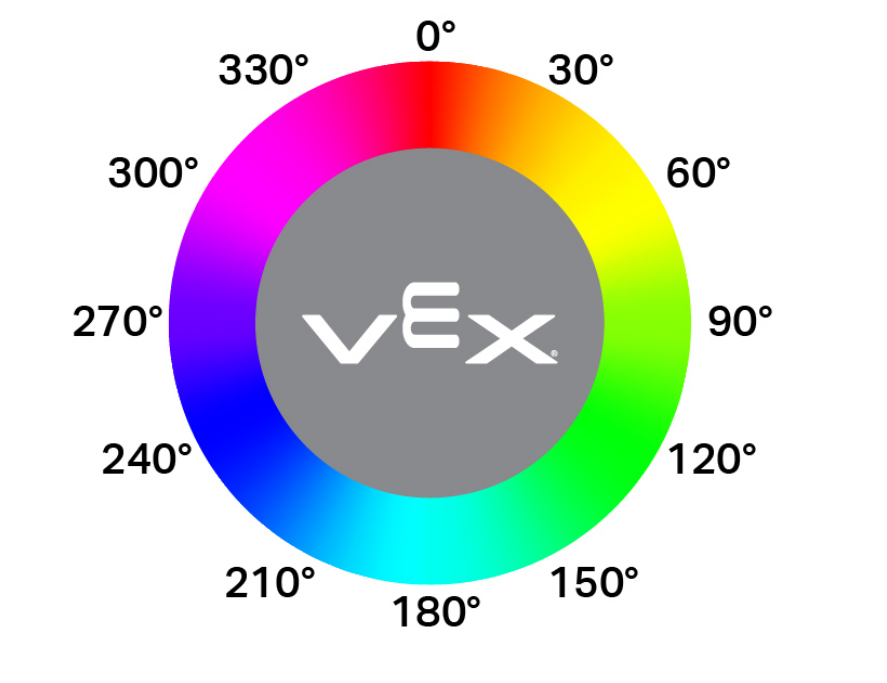
hue returns the value of the hue detected by the Optical Sensor as a float in the range of 0 to 359.99 degrees.
Η απόχρωση είναι ένας τρόπος περιγραφής του χρώματος χρησιμοποιώντας αριθμούς γύρω από έναν χρωματικό κύκλο, όπως φαίνεται παρακάτω.
Usage:
optical_1.hue()
Παράμετροι |
Περιγραφή |
|---|---|
Αυτή η μέθοδος δεν έχει παραμέτρους. |
# Check the hue of a detected object
# to determine if it is pink
while True:
    brain.screen.clear_screen()
    brain.screen.set_cursor(1, 1)
    if 290 < optical_1.hue() < 350:
        brain.screen.print("Pink!")
        wait(0.1,SECONDS)
    else:
        brain.screen.print("Not pink.")
        wait(0.1,SECONDS)
rgb#
rgb returns the red, green, blue, and brightness values detected by the Optical Sensor as a Tuple.
Usage:
optical_1.rgb(raw)
Παράμετροι |
Περιγραφή |
|---|---|
|
Optional. A Boolean value to determine if you return raw or processed values:
|
# Display the rgb values and brightness detected
# by the Optical Sensor.
brain.screen.set_font(FontType.MONO12)
while True:
    brain.screen.clear_screen()
    brain.screen.set_cursor(1, 1)
    brain.screen.print(optical_1.rgb())
    wait(0.1, SECONDS)
installed#
installed returns a Boolean indicating whether the Optical Sensor is connected to the Brain.
True— The Optical Sensor is connected to the Brain.False— The Optical Sensor is not connected to the Brain.
Usage:
optical_1.installed()
Παράμετροι |
Περιγραφή |
|---|---|
Αυτή η μέθοδος δεν έχει παραμέτρους. |
# Display a message if the Optical Sensor
# is installed.
if optical_1.installed():
    brain.screen.print("Installed!")
Επανάκληση#
object_detected#
object_detected registers a callback function for when an object is detected.
Usage:
optical_1.object_detected(callback, arg)
Παράμετροι |
Περιγραφή |
|---|---|
|
Μια συνάρτηση που έχει οριστεί προηγουμένως για εκτέλεση όταν ανιχνεύεται ένα αντικείμενο. |
|
Προαιρετικό. Μια πλειάδα που περιέχει ορίσματα για να μεταβιβαστούν στη συνάρτηση επανάκλησης. Δείτε Συναρτήσεις με Παραμέτρους για περισσότερες πληροφορίες. |
def detected():
    drivetrain.stop()
    brain.screen.set_cursor(1, 1)
    brain.screen.print("object detected")
    wait(0.5,SECONDS)
    brain.screen.clear_screen()

# Display a message when the
# Optical Sensor detects an object
drivetrain.drive(FORWARD)
optical_1.object_detected(detected)
object_lost#
object_lost registers a callback function for when the Optical Sensor loses a detected object.
Usage:
optical_1.object_lost(callback, arg)
Παράμετροι |
Περιγραφή |
|---|---|
|
Μια συνάρτηση που έχει οριστεί προηγουμένως για εκτέλεση όταν χάνεται ένα αντικείμενο. |
|
Προαιρετικό. Μια πλειάδα που περιέχει ορίσματα για να μεταβιβαστούν στη συνάρτηση επανάκλησης. Δείτε Συναρτήσεις με Παραμέτρους για περισσότερες πληροφορίες. |
def lost():
    drivetrain.stop()
    brain.screen.set_cursor(1, 1)
    brain.screen.print("object lost")
    wait(0.5,SECONDS)
    brain.screen.clear_screen()

# Display a message when the Optical
# Sensor loses sight of on object
drivetrain.drive(REVERSE)
optical_1.object_lost(lost)
Κατασκευαστές#
Constructors are used to manually create Optical objects, which are necessary for configuring an Optical Sensor outside of VEXcode.
Optical#
Optical creates an Optical Sensor.
Usage:
Optical(smartport)
Παράμετρος |
Περιγραφή |
|---|---|
|
Η Έξυπνη Θύρα στην οποία είναι συνδεδεμένος ο Οπτικός Αισθητήρας, γράφεται ως PORTx όπου x είναι ο αριθμός της θύρας. |
# Construct an Optical Sensor "optical_1" with the
# Optical class
optical_1 = Optical(Ports.PORT1)

# Display the brightness of a red object detected
# by the Optical Sensor
drivetrain.turn(RIGHT)
while not optical_1.color() == Color.RED:
    wait(50, MSEC)
drivetrain.stop()
brain.screen.print(optical_1.brightness())